APPLY
APPLY GIVE
GIVE CHALLENGE


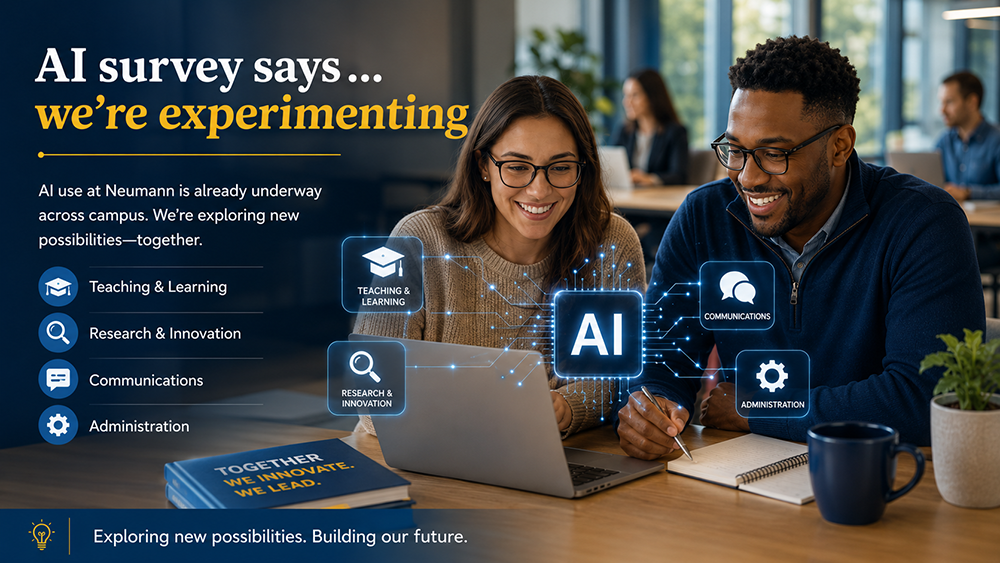
Image created by ChatGPT via prompt: can you generate a 16 by 9 horizontal image to go with this story?
Editor’s note: This article was not written by Claude, ChatGPT, Gemini, or Co-Pilot. Full disclosure – the writer always uses spell-check.
The results of a spring survey about AI usage on campus show that “AI use at Neumann is already underway across faculty and staff, but adoption is uneven, informal, and guided largely by individual judgment rather than shared institutional direction” according to an executive summary of the findings written by Dr. Najiba Benabess.
Benabess describes campus as being “in an early adoption and cautious experimentation phase,” noting that “AI is already present in teaching, advising, communications, research, marketing, advancement, enrollment, and administrative workflows.”
The survey generated 103 responses: 49 from faculty and 54 from staff members. Neumann employs approximately 260 people. Students were not included in the survey.
Use of AI on campus appears to be broad. Thirty-eight faculty respondents (77%) reported using generative/conversational AI. Among staff, 65% of respondents indicated that AI tools are currently being used in their area.
The top concerns about AI were academic integrity, which worried the faculty, and privacy/security, the primary misgiving among staff. Both audiences also voiced apprehensions about accuracy, bias, the impact on student learning, workload expectations, and lack of training.
Respondents expressed strong interest in AI workshops as well as learning about best practices and approved tools.
The report recommends the development of a “centralized, institution-wide AI resource hub within the NU Portal titled ‘AI @ Neumann’ to serve as the primary access point for AI guidance, resources, training, and updates for the campus community.”
Such a hub, Benabess writes, might include AI policies and guidelines, a list of approved tools, workshop recordings, upcoming training opportunities, FAQs, pilot projects, examples of successful implementation, and mission-centered guidance connecting AI to Catholic Franciscan values, ethics, human dignity, and environmental stewardship.
Other suggestions were to create a flexible green/yellow/red framework, allowing faculty to communicate AI expectations clearly in their course syllabi, and to prioritize AI literacy and ethical use.
AI Council will reconvene in late August to discuss the results and plan next steps.
Benabess is associate provost for online learning, AI, and academic partnerships; dean of the School of Business; and co-chair of the AI Council. In November 2023, she published Irreplaceable Human Intelligence: Surpassing AI Outreach, which explores the critical role of human intellect in the age of artificial intelligence.