APPLY
APPLY GIVE
GIVE CHALLENGE


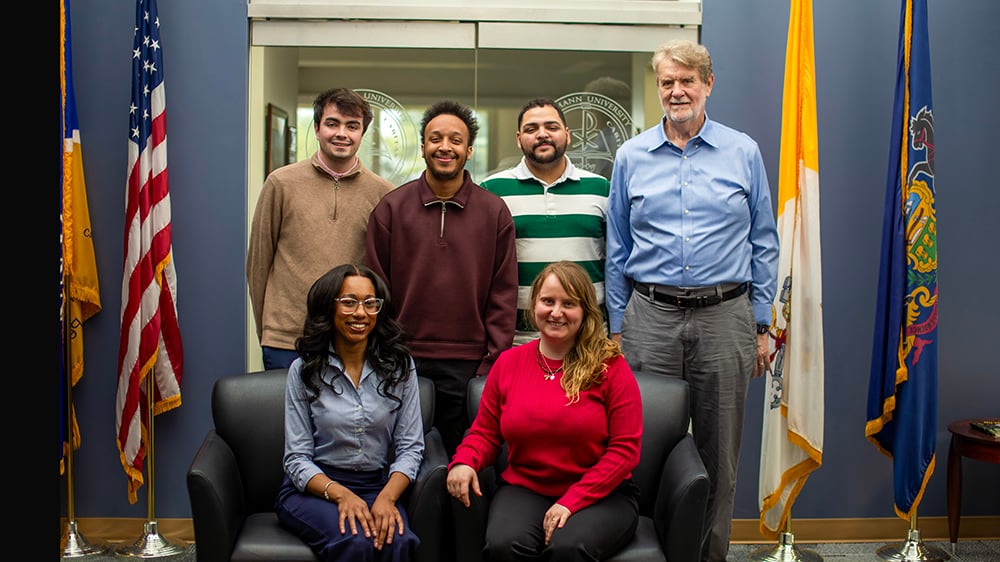
Creators of the Nafasi website are (sitting) Chloe Cosley and Sara Cieszko, and (standing) Jack Trainor, Brandon Stevenson, Cristopher Espinal, and Dr. Tom Dodds. Missing are Danielle DiNafo, Rocky Keophondeth, and Nidhin Radhesh.
A Dublin-based organization is about to launch a worldwide philanthropic matchmaking program, made possible by a digital ledger and tracking system that eight cybersecurity majors developed in their capstone course with Professor Tom Dodds.
Nafasi is a self-described “global social enterprise,” the goal of which is to match mentoring and funding resources from the global north with tech entrepreneurs in Africa to promote economic growth and employment.
Catrina Sheridan, founder of Nafasi, has been advising aspiring tech innovators in Africa since she founded the organization in 2019. The student-created digital ledger, she says, will allow Nafasi to connect willing donors with these entrepreneurs and make a significant philanthropic impact.
The website that the students created for Nafasi uses Polygon blockchain technology to provide an easily managed, transparent and secure digital record, ensuring that aid reaches local beneficiaries and that funders can track expenses incurred by the entrepreneurs.
According to Sheridan, blockchain technology is a decentralized digital ledger that records transactions across a network of computers without intermediaries. Data is stored in cryptographically linked blocks, and only the system administrator can make a transaction official.
“The students’ prototype has an integration with Flutterwave, which enables digital payments to be created and appear in a digital wallet,” Sheridan explains. “Another program tracks receipts so that the system provides accountability.”
Nafasi (the Swahili word for “opportunity”) has clients in six African countries. The Beta testing for the students’ system will occur in Kenya, Nigeria, and South Africa, matching entrepreneurs there with donors from the US, UK, and Ireland.
Sheridan expects the Beta test to be completed by the end of 2026, at which time she hopes to use the results to approach the Irish government and other multilateral agencies for financial support to expand her organization’s efforts.
Senior Sara Cieszko, an international student from Poland, led the May 8 presentation to Sheridan with classmates Chloe Cosley, Danielle DiNafo, Cristopher Espinal, Rocky Keophondeth, Nidhin Radhesh, Brandon Stevenson, and John Trainor.
Cieszko believes that the semester-long project immersed her team in a real-world business experience, including a spring break trip to Dublin to present their preliminary plans to Sheridan and members of Nafasi’s advisory board.
During that overseas business trip, the students encountered an unforeseen obstacle. They discovered that they couldn’t use Stripe, one of the technologies that Sheridan had originally recommended, because the platform uses banking accounts, not mobile wallets. Eighty percent of African communities use mobile wallets.
“We hit the wall,” Cieszko recalls.
When the class returned to the States, they had to regroup, find an alternate payment system that suited the entrepreneurs, and update their presentation in just two months. They found Flutterwave, a platform which worked for all participants in the process.
“It was really empowering to be part of a real conversation in the business world and create a solution,” Cieszko smiles.
“Seeing this entire project come together -- after tons of research and having people implement and present their solutions – is gratifying. It felt like we were working together as a company, and Catrina is so grateful for the outcome. Knowing that she’ll be able to use it at the next level is the best part.”
Professor Dodds agrees. “I am incredibly proud of these students,” he says.
“Starting from zero on technology most of them had never heard of, they built a fully functional web platform on par with what seasoned consulting firms produce. Watching a student team pull that off was extraordinary. In fact, what they created and presented to Nafasi will literally change the lives of many African entrepreneurs.”
Sheridan called the students’ work “impressive.”
Other staff members assisted Dodds with the project. Neumann’s connection with Nafasi came through a university partnership with the International Study Program, a relationship forged by Victor Betancourt, the associate provost for global engagement. Preeti Singh, director of career and professional development, handled the logistics for the business trip to Dublin.
Sheridan is a prominent figure in the Irish tech community, having served as a mentor for Enterprise Ireland and as a Board Director for SOLAS, Ireland’s further education and training authority. She has also worked in senior roles for international charities.
Cieszko is in America on a student visa and must find a job by September 20 to stay in the country. She has no doubt that a resume which prominently features the Nafasi project will help her search.